

Table of content
- What Does "Affordable" Actually Mean in Concord, CA?
- Which Neighborhoods in Concord Have the Most Affordable Home Prices?
- Should I Buy a Condo or a House in Concord for Affordability?
- How Does BART Access Affect Home Prices in Concord?
- What Should First-Time Buyers Know About Buying in Concord, CA?
- Are There Income-Based Affordable Housing Programs in Concord?
- How the Renée White Team Helps Buyers Find Affordable Housing in Concord, CA
- The Bottom Line on Affordable Housing in Concord, CA
- Frequently Asked Questions
KEY TAKEAWAYS
- Concord’s western zip codes (94520 and 94519) tend to have the lowest prices in the city
- Condos and townhomes start under $530,000; single-family homes start around $605,000
- Holbrook Heights and Dana Estates are well-known among local buyers for solid value
- Homes closest to the Concord BART station carry a price premium; being a short drive away is the better deal
- Budget for closing costs, property taxes, and HOA fees on top of the purchase price – the Renée White Team walks every buyer through the full cost picture before they make an offer
If you’ve been searching for affordable housing in Concord, CA, and wondering whether buying a home is still realistic on a normal income, you’re not alone. The Harvard Joint Center for Housing Studies’ 2026 State of the Nation’s Housing report found that the number of homes affordable to households earning $75,000 or less dropped by 60 percent between 2019 and 2026. Nationally, homes now cost nearly five times the typical household income, a ratio that hadn’t been seen since before the 1990s.
Concord is a different story, and that’s exactly the point. At around $758,000, Concord’s median sale price is roughly half what you’d pay for a comparable home in much of the Bay Area. If you’ve been comparing your options across Contra Costa County, our Walnut Creek vs. Concord comparison guide breaks down how the two cities stack up on price, lifestyle, and commute. The Renée White Team has helped buyers navigate this exact decision for over 21 years and 1,600+ transactions in Contra Costa County. Here’s where to focus your search, and what to realistically expect.
What Does “Affordable” Actually Mean in Concord, CA?
Let’s be honest: affordable housing in Concord is not cheap housing. The city’s median sale price sits between $736,000 and $758,000 as of mid-2026, according to Redfin. For a look at where prices are trending, our Concord Housing Market guide covers current data and forecasts in detail.
“Affordable” here means lower than the surrounding market, and in the Bay Area, that gap is significant. A home that costs $620,000 in Concord might run $1.1 million in Walnut Creek and over $1.4 million in Danville. For buyers priced out of those cities, Concord isn’t a fallback; it’s the smart move.
Concord’s prices are not uniform. The southeast side costs more. The west side is where the value is.

Which Neighborhoods in Concord Have the Most Affordable Home Prices?
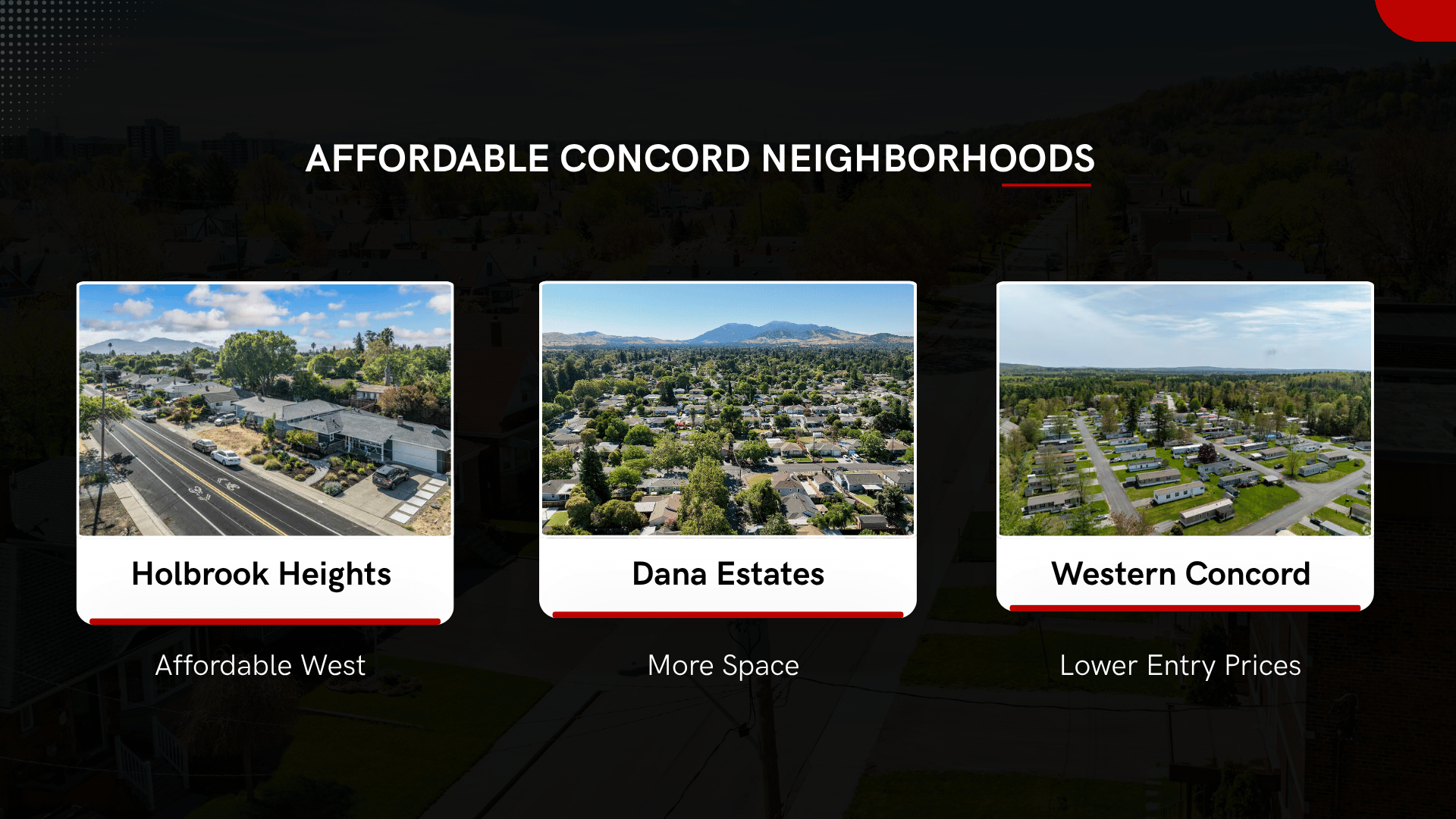
Not all of Concord is priced the same. Data from BestNeighborhood.org shows that the city’s most affordable areas are concentrated in the west, while the southeastern side carries higher price points. For a full breakdown of Concord’s neighborhoods, including schools, zip codes, and what each area is actually like to live in, see our Concord Neighborhoods guide.
Holbrook Heights
Holbrook Heights sits in Concord’s more affordable western section and gives buyers easy access to Highway 4 and Highway 242, a practical plus for anyone commuting by car to other parts of the East Bay.
It’s a good fit for two types of buyers: first-timers looking for a realistic entry point, and buyers who don’t mind putting some work into a home in exchange for a lower price. The homes here are established single-family properties; they have a sense of place and settled character that newer developments often don’t.
Dana Estates
Dana Estates comes up repeatedly when local buyers talk about value. It offers larger lots and varied property types at prices that don’t carry the premium you’d pay on the southeast side of Concord or in neighboring Walnut Creek. If you want more space per dollar, whether that’s for a growing family, a garden, or just room to breathe, this neighborhood consistently delivers.
It’s an established area, which matters. You’re not buying into a neighborhood in flux; you’re buying into one with mature trees, long-term residents, and stable pricing that still reflects genuine market value.
Western Concord (Zip Codes 94520 and 94519)
At the zip code level, 94520 and 94519 are where Concord’s most competitive entry-level prices are. Recent sales data from Redfin shows single-family homes in 94520 selling in the $605,000 to $700,000 range for move-in-ready properties, with 94519 showing similar numbers.
Buyers willing to update a kitchen, repaint, or handle some deferred maintenance will find the best per-square-foot prices here. The trade-off is real: these homes may need more work than turnkey listings elsewhere in Concord. But for buyers with a budget for improvements, western Concord is consistently where the value is.
Should I Buy a Condo or a House in Concord for Affordability?
It’s one of the first questions buyers ask, and the honest answer is: it depends on your priorities. Here’s a side-by-side look:
| Condo / Townhome | Single-Family Home | |
| Entry Price Range | $398,000 – $530,000 | $605,000 – $700,000 |
| HOA Fees | $300 – $1,000+/month | None |
| Property Taxes (~1.1%) | ~$4,400 – $5,800/yr | ~$6,650 – $7,700/yr |
| Long-Term Appreciation | Moderate | Historically stronger |
| Best For | Fastest path to ownership | Buyers planning 5+ years |
| Key Trade-off | HOA narrows the price gap | Higher upfront cost |
Condos get you in the door at a lower price, but HOA fees, anywhere from $300 to $1,000+ per month, can eat into those savings faster than buyers expect. Single-family homes cost more upfront and skip the HOA, and they tend to hold and grow value more strongly over time. Neither path is wrong. What matters is running the real numbers before you commit. Our Condo Buying Guide breaks down the HOA and resale value equation in detail.
How Does BART Access Affect Home Prices in Concord?
BART is a genuine selling point for Concord buyers who commute into San Francisco or Oakland, but how close you are to the station has a direct effect on price. Here’s what to know:
- Walkable to BART = higher price tag: Homes within walking distance of the Concord BART station cost more per square foot. If you need to walk to the train, plan your budget accordingly.
- A short drive away is the sweet spot: Five to ten minutes from the station keeps BART within easy reach without paying the walkability premium. Most of Concord’s best-value homes fall into this zone.
- Remote workers and drivers have the most options: The farther you’re willing to go from the station, the more your dollar stretches, and western Concord’s most affordable streets reflect that flexibility.
- BART proximity still adds resale value long-term: Even if you never ride BART, future buyers will care about it, which supports your home’s value over time.
Our homes near BART in Concord guide maps out which areas hit that commute sweet spot, and our Contra Costa County commute guide compares transit, highway, and remote work options across the county.
What Should First-Time Buyers Know About Buying in Concord, CA?

Concord is one of the more realistic markets in the Bay Area for first-time buyers, but realistic doesn’t mean easy. Our First-Time Home Buyer Guide to Concord, CA walks through the full process, from down payment planning to closing. Here’s what catches buyers off guard most often.
Get Pre-Approved for the Right Loan Type
Most single-family purchases in Concord will exceed standard conforming loan limits, so many buyers will need a jumbo loan. Jumbo loans come with stricter requirements: higher credit scores, lower debt levels, and larger cash reserves. Talk to a lender before you start touring homes, so you know exactly what you qualify for, not after you’ve fallen for a property.
Condo buyers at lower price points may qualify for standard financing, but lenders will also look at the condo association’s financial health and how many units are owner-occupied before approving the loan. Don’t assume a lower price means a simpler process.
Budget for More Than the Purchase Price
The sticker price is only part of what you’ll pay. Closing costs in Contra Costa County typically run one to three percent of the purchase price. On a $650,000 home, that’s $6,500 to $19,500 on top of your down payment. Property taxes run about 1.1 percent of the assessed value per year. Our Contra Costa County Property Tax guide explains how to look up your specific bill and what to do if you think it’s wrong. If you’re buying a condo, add HOA fees to your monthly number.
Build the full cost picture with your agent and lender before you get attached to a specific property.
Move Fast When the Right Home Appears
Good homes in Concord’s more affordable areas move quickly. The Renée White Team’s listings across Contra Costa County average 23 days on the market. Buyers who are pre-approved and working with someone who knows the local inventory can make competitive offers on short notice. Those who are still getting their paperwork together often miss out. Being ready isn’t about rushing; it’s about not losing a home you actually wanted.

Are There Income-Based Affordable Housing Programs in Concord?
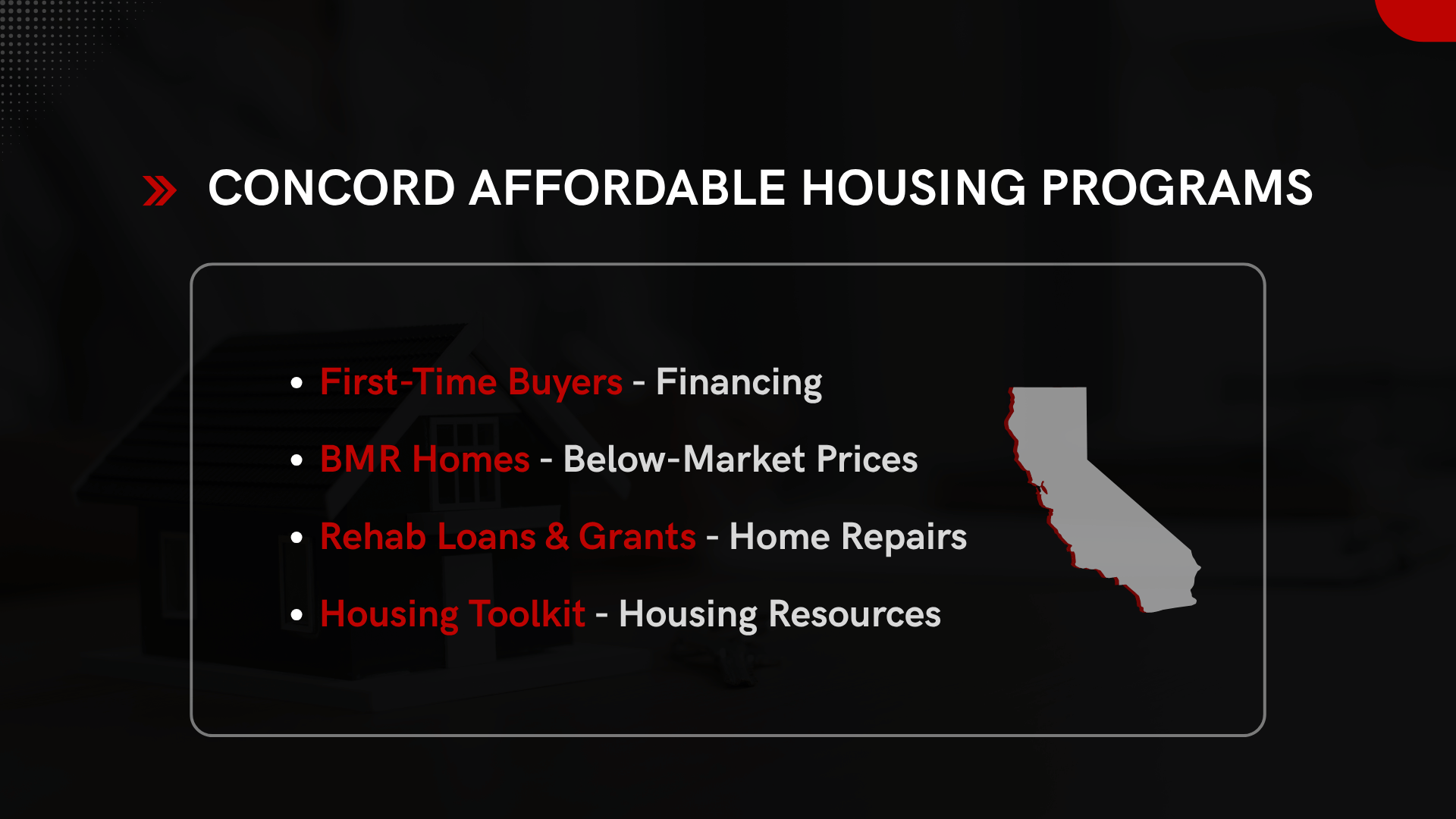
Some buyers searching for affordable housing in Concord, CA are looking for income-restricted or subsidized programs, not open-market options. The City of Concord offers several through its Housing & Community Services Division.
First Time Homebuyer Program
Helps income-qualified first-time buyers with financing. Eligibility thresholds are updated annually. Call the city’s housing team at 925-671-3387 for current limits.
Below Market Rate (BMR) Homeownership
Lets qualified buyers purchase homes at prices set below the market rate. Units are limited and availability changes, so it’s worth checking in directly with the city.
Homeowner Rehabilitation Loans & Grants
Assists current Concord homeowners with funding for necessary repairs or improvements, through loans or grants depending on income and project scope.
Affordable Housing Toolkit
The city’s Affordable Housing Toolkit includes an interactive map of available units, guides in English and Spanish, and the Doorway Search Tool for Bay Area housing resources.
Income limits and program details change each year. Verify everything directly with the city before making decisions based on what you read online, including here. This article focuses on what regular buyers can find in the open market, but if you qualify for any of these programs, they’re worth looking into first.
How the Renée White Team Helps Buyers Find Affordable Housing in Concord, CA
Knowing which zip codes to focus on is a start. What actually gets buyers into homes is having an agent who knows when a listing is priced right and can move quickly when it is. Here’s what the Renée White Team brings:
- 1,600+ transactions and 21 years in Contra Costa County: the team knows which neighborhoods are priced fairly and which ones aren’t worth the ask
- Average 23 days on market: well-priced homes in Concord move fast, and buyers need to be ready when they do
- Neighborhood-level pricing knowledge: not just zip codes, but specific streets and blocks where value is highest
- Offer strategy: knowing when to move aggressively and when to hold is how buyers avoid overpaying
- Support from search through close, whether you’re buying your first home or relocating from out of the area
Reach out directly to talk through what fits your budget.
The Bottom Line on Affordable Housing in Concord, CA
Concord isn’t a secret, but it remains one of the most realistic options for buyers in Contra Costa County who are willing to look beyond the better-known cities nearby. The neighborhoods and price points in this guide are where the Renée White Team directs buyers every week, not as a compromise, but as the right call given what the market actually offers right now.
If you’re still choosing an agent, our guide to finding a real estate agent in Concord covers the ten questions worth asking before you commit. If you’re ready to talk about what’s available in your budget, our team is here.