Table of content
- Where Is Walnut Creek BART Station Located?
- What Transit Options Does Walnut Creek BART Station Offer?
- What Are the Parking Options at Walnut Creek BART Station?
- How Do I Get from Walnut Creek Station to San Francisco and SFO?
- Is Walnut Creek BART Station Bike-Friendly?
- Accessibility at Walnut Creek BART Station
- What's Near Walnut Creek BART Station?
- Why Walnut Creek BART Station Matters for Central Contra Costa County
- How Can the Renée White Team Help You Buy or Sell Near Walnut Creek BART?
- Is Walnut Creek BART Station the Right Transit Hub for Your Commute and Your Next Home?
- Frequently Asked Questions
KEY TAKEAWAYS
- Walnut Creek BART station sits on the Antioch-SFO/Millbrae line, with direct service to San Francisco and San Francisco International Airport
- Parking is split between two garages: a BART-operated North Garage and a privately operated South Garage, with different rates and rules
- County Connection buses, along with SolTrans and WHEELS routes, connect the station to Central Contra Costa County and beyond
- The station is fully accessible, with elevators serving both platforms and a Clipper card system for fare payment
- Downtown Walnut Creek, including Broadway Plaza and the Lesher Center for the Arts, is within walking distance of the station, a proximity the Renée White Team often points to when clients weigh location against commute access
If you’re planning a trip through Central Contra Costa County, Walnut Creek BART station is probably part of that plan. It’s one of the busiest stops on the Bay Area Rapid Transit system, connecting commuters, residents, and visitors to San Francisco, Oakland, San Francisco International Airport, and the wider Bay Area, all from a single elevated platform on Ygnacio Valley Road.
This guide answers the questions people actually search for before a trip: where the station is, how parking works across the two garages, which buses connect here, how long the ride to San Francisco takes, and what’s within walking distance in downtown Walnut Creek. It’s written for commuters weighing a daily BART routine, occasional riders headed into the city, and residents who want to use the station without guesswork.
And beyond convenience, a station like this shapes how a city grows, how residents get to work, and, as the research below shows, how much homes near it are worth. The Renée White Team regularly discusses this with clients weighing where to settle in Contra Costa County. If you’re still exploring the area, our guides on moving to Walnut Creek and the Walnut Creek cost of living are a good place to start.
Where Is Walnut Creek BART Station Located?
Walnut Creek BART station is at 200 Ygnacio Valley Road, Walnut Creek, CA 94596. The station sits on an elevated structure near Interstate 680, just north of downtown Walnut Creek. It opened on May 21, 1973.
The station serves the Yellow Line, connecting Antioch to San Francisco International Airport and Millbrae. Two side platforms handle northbound and southbound service, with the paid fare lobby between them and elevator access on the south side.
What Transit Options Does Walnut Creek BART Station Offer?
Walnut Creek station connects to several bus services, so you’re not limited to just BART when you arrive.
County Connection
County Connection runs the largest share of routes here, with weekday service on Routes 1, 4, 5, 9, 14, 21, 93X, 95X, 96X, and 98X, and weekend service on Routes 4, 301, 311, and 321. A few routes worth knowing:
- Route 4, the Downtown Trolley, is a free, hop-on-hop-off shuttle running seven days a week between the station and downtown Walnut Creek’s shopping, dining, and entertainment district, with buses every 20 minutes
- Route 5, the Creekside Shuttle, runs weekdays to Kaiser Hospital, Los Lomas High School, and neighborhoods along Creekside Drive
- Route 14, the Monument Shuttle, connects Walnut Creek BART to Concord BART on weekdays
SolTrans & WHEELS
The station is also served by SolTrans Solano Express (Yellow and Blue Lines) and WHEELS Route 70X, which runs express to Dublin BART, useful for anyone heading toward the Tri-Valley area. All of these buses stop in the busway inside the South Garage, so transferring between BART and a connecting bus is usually a short walk, not a street crossing.
BART and its connecting bus routes all run on the Clipper card, so one card covers every leg of a trip.

What Are the Parking Options at Walnut Creek BART Station?

Parking is where most first-time riders get tripped up, because Walnut Creek BART station has two separate garages with two separate owners.
North Garage
The North Garage is BART-operated. Daily parking is $5 per day, purchased through the BART Official app. Other options include carpool parking at $5 per day, Single/Multi-Day Reserved spaces at $9 per day, and Monthly Reserved parking at $136.50 per month.
South Garage
The South Garage is privately owned and costs $8 per day. The key detail: parking purchased through BART is not valid here. You must buy separately through wcbartparking.com or the kiosks inside the garage. Using the wrong ticket in the wrong garage is a common and avoidable way to get cited.
Between the two garages, the station has 2,089 total spaces, and capacity is generally available throughout the day. Check BART’s official parking page before you leave for current rates and any changes.
How Do I Get from Walnut Creek Station to San Francisco and SFO?
Walnut Creek Station is on the Yellow Line, with trains departing roughly every 10 to 15 minutes during peak weekday hours. A southbound ride into San Francisco takes around 45 to 55 minutes depending on your destination station.
For San Francisco International Airport, the same Yellow Line service continues through to the SFO/Millbrae line with no transfer required, and a total travel time of roughly 55 to 70 minutes. For residents across Central Contra Costa County who’d otherwise face a long drive during rush hour, this is a practical alternative.
Fares are calculated by distance and applied automatically when you tap a Clipper card. Use BART’s online fare calculator to confirm the exact cost to San Francisco, SFO, Oakland, or any other stop before you travel.
Is Walnut Creek BART Station Bike-Friendly?
Yes. The station has standard bike racks and 72 on-demand BikeLink lockers near the south elevator entrance for riders who want secure, weatherproof storage. BikeLink lockers use a BikeLink card and charge per use, a reasonable option for riders coming from just beyond comfortable walking distance.
There’s no bike-share program at this station. Bikes are allowed on BART trains outside of the most restricted peak-hour car sections, following standard system-wide rules.
Accessibility at Walnut Creek BART Station
Both platforms have elevators: one for Platform 1 (Antioch direction) and one for Platform 2 (San Francisco, Millbrae, and SFO direction). Clipper card faregates are at the elevator enclosure on the platform level. Paratransit service and the Regional Transit Connection (RTC) discount card are available for eligible riders. BART maintains a real-time elevator status page you can check before arriving.
What’s Near Walnut Creek BART Station?
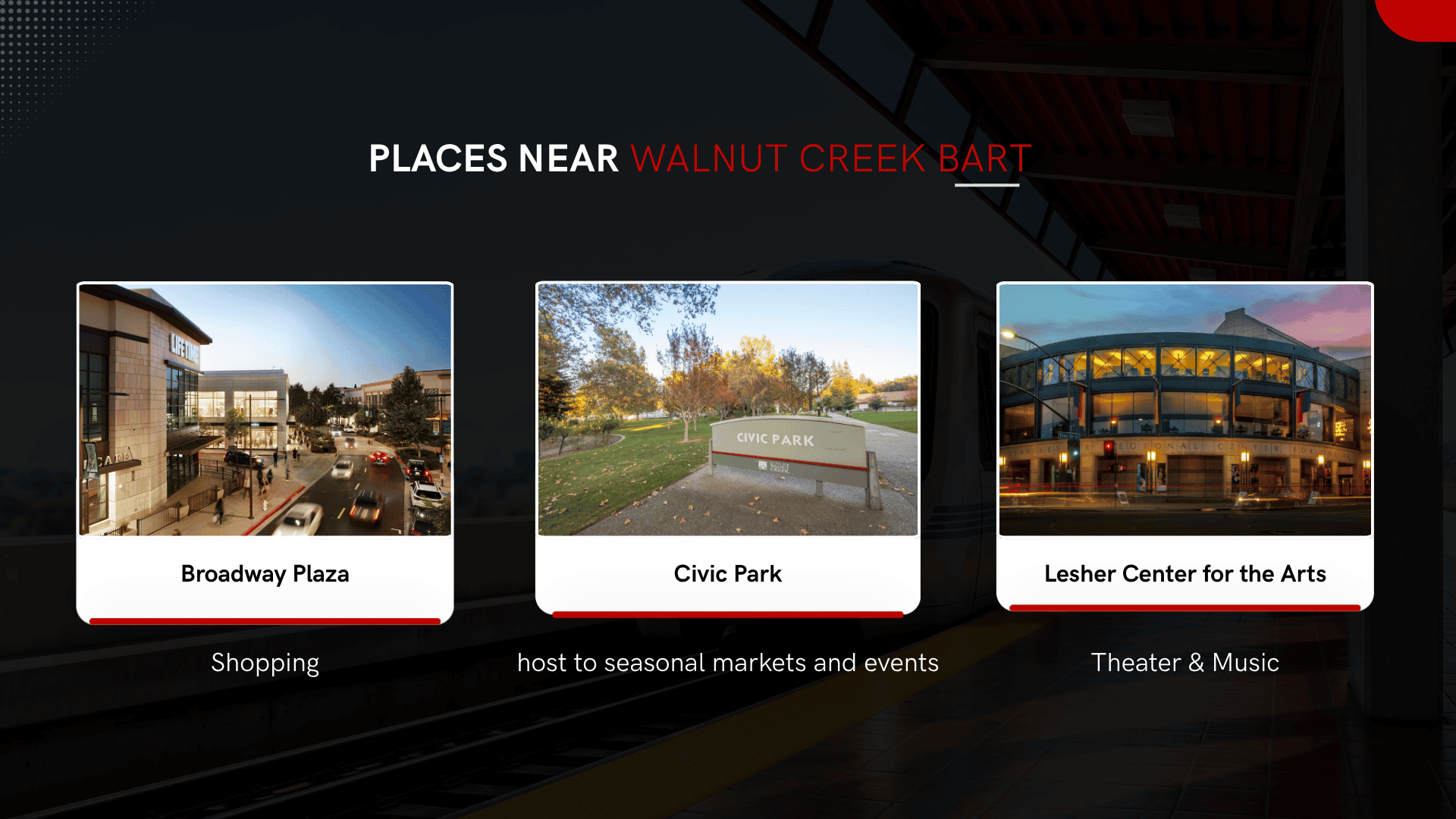
The station sits closer to downtown Walnut Creek than many riders expect. Within a short walk or a quick ride on the free Downtown Trolley:
- Broadway Plaza – a major shopping destination
- Civic Park – host to seasonal markets and events
- Lesher Center for the Arts – home to regional theater and music performances
See our full guide to things to do in Walnut Creek and a breakdown of the city’s best neighborhoods for more on what’s within reach.

Why Walnut Creek BART Station Matters for Central Contra Costa County

Beyond day-to-day convenience, transit access at a station like this carries measurable economic and public health weight, and this is where independent research tells the real story.
Property Values Near the Station
A 2014 property value study commissioned by BART found that condominiums within a half-mile of a BART station carry roughly a 15 percent price premium over comparable units five or more miles away, an average of about $69,052 in 2012 dollars, while single-family homes within a half-mile show a 10.7 percent premium, or roughly $72,199 more than distant homes.
The same study found BART station areas across three counties generate over $750 million annually in property tax revenue, despite occupying just 2 percent of the region’s land. For a current look at how these dynamics play out locally, see our Walnut Creek housing market forecast and the condo buying guide for Walnut Creek, which covers HOA fees and resale value in BART-adjacent buildings.
Independent Confirmation from Fremont’s BART Extension
A separate, peer-reviewed analysis from the Mineta Transportation Institute at San José State University, examining the newer Warm Springs BART extension in Fremont, found that proximity to that station was associated with a 9 to 15 percent increase in the price of nearby single-family homes, a finding that holds up across more than one corridor.
Economic Returns on Transit Investment
The American Public Transportation Association reports that planned public transportation investments yield roughly a 2-to-1 return, and that transit-driven growth in emerging tech hubs generated more than $174 billion in business sales across the metro areas studied.
Public Health Benefits of Transit Use
A peer-reviewed study published via the National Institutes of Health examined transportation-related health benefits across the San Francisco Bay Area, finding that shifting trips toward active and low-carbon transportation reduced the combined burden of cardiovascular disease and diabetes by 14 percent under a combined-strategy scenario.
These studies point to the same conclusion from different angles: a well-used station like Walnut Creek BART doesn’t just move people. It measurably shapes property values, local tax revenue, and public health outcomes across the surrounding community.
How Can the Renée White Team Help You Buy or Sell Near Walnut Creek BART?
For over two decades, the Renée White Team has helped buyers and sellers across Contra Costa County make confident decisions, and BART access comes up in nearly every conversation about where to live. Here’s how they can help:
- Buyers – Weigh a walkable-to-BART condo against a larger home further out, with clear guidance on which blocks fall inside the premium half-mile radius and what that means for long-term value. Our first-time home buyer guide to Walnut Creek walks through the full process.
- Sellers – Understand how transit proximity affects your listing price and how to position BART access as a feature that drives buyer interest. See our seller’s guide for Walnut Creek for a step-by-step breakdown.
- Relocating professionals – Find the right balance between commute convenience and neighborhood fit, whether you’re in San Francisco two days a week or five. Our guide on commuting in Contra Costa County covers every major route.
As the #1 real estate team in Contra Costa County by units, with over 1,600 transactions and $1.4 billion in career sales volume, the Renée White Team brings local knowledge that doesn’t show up in a search filter.
Is Walnut Creek BART Station the Right Transit Hub for Your Commute and Your Next Home?
Walnut Creek BART Station is a working piece of infrastructure that connects Central Contra Costa County to San Francisco, SFO, and the wider Bay Area, while anchoring the daily rhythm of downtown Walnut Creek itself. Between the two parking garages, the network of connecting buses, secure bike storage, and full platform accessibility, most questions a rider has can be answered before they ever leave home.
The research confirms what many residents already sense: proximity to a station like this carries real, measurable value for property owners, for the local tax base, and for public health across the region. If you’re weighing how BART access should factor into a home search in Walnut Creek or elsewhere in Contra Costa County, the Renée White Team has been helping buyers navigate exactly that trade-off for over 20 years. Browse current homes for sale in Walnut Creek to see what’s available near the station right now.